

3D Printer Filament in India Print What Actually Works
Filament is where most print failures begin. Wrong material for the application, moisture-damaged spools, poor diameter consistency, or a filament that was never designed for the speeds your printer runs these are the real reasons prints fail, not the printer itself. At Hydrotech 3D Chennai, we have seen it enough times to say it plainly: the filament you choose matters as much as the machine you print on.
We stock filament from Bambu Lab and Elegoo two brands we have evaluated not just for print quality, but for consistency across spools, honest tolerance specifications, and reliable availability in India. Every spool we carry is genuine stock, vacuum-sealed at source, and dispatched with adequate shelf life. Our customers in Chennai and across India know that what they order from us prints the same way every time not just the first spool.






Filament and the Indian Climate What Nobody Tells You
Most filament guides are written for temperate climates. India is different. Humidity levels in Chennai, Mumbai, Kolkata, and coastal cities regularly exceed 70–90% during monsoon and that has direct consequences for filament storage and print quality that most buyers discover only after a failed spool.
Thermoplastic filaments especially PETG, TPU, Nylon, and ABS are hygroscopic: they absorb moisture from the air. When you run wet filament through a hot-end, the moisture turns to steam, causing micro-bubbling, stringing, weak layer adhesion, and rough surfaces. A spool that printed perfectly in December can fail in August simply because it was left open. PLA is more forgiving than most, but even PLA+ will show quality degradation if stored exposed through a Chennai monsoon season.
This is why we recommend buying from a dealer who stores filament correctly and why we use vacuum-sealed stock from Bambu Lab, which ships every spool sealed with desiccant. For filament you are storing yourself: keep it in airtight containers or zip-lock bags with silica gel desiccant, and dry any suspect spool before printing (PLA at 50°C for 4–6 hours, PETG at 65°C for 4–6 hours, ABS/ASA at 70°C for 4–6 hours, using a food dehydrator or oven on its lowest setting).
3D Printer Filament in India Print What Actually Works
Filament is where most print failures begin. Wrong material for the application, moisture-damaged spools, poor diameter consistency, or a filament that was never designed for the speeds your printer runs these are the real reasons prints fail, not the printer itself. At Hydrotech 3D Chennai, we have seen it enough times to say it plainly: the filament you choose matters as much as the machine you print on.
We stock filament from Bambu Lab and Elegoo two brands we have evaluated not just for print quality, but for consistency across spools, honest tolerance specifications, and reliable availability in India. Every spool we carry is genuine stock, vacuum-sealed at source, and dispatched with adequate shelf life. Our customers in Chennai and across India know that what they order from us prints the same way every time not just the first spool.
3D Printer Price in India What to Expect Across Categories
One of the most common questions we receive is: "How much does a 3D printer cost in India?" The honest answer is that 3D printer prices in India span a wide range depending on technology, build volume, speed, and brand. Here is a realistic guide based on what we see our customers buying:
Filament Type | Key Traits | Best For | Enclosure Needed? |
|---|---|---|---|
PLA / PLA+ | Easy to print, low warp, biodegradable | Prototypes, models, decor, education, hobbyists | No |
PETG | Tough, water-resistant, slightly flexible | Functional parts, outdoor items, food-safe containers, enclosures | No (recommended for large prints) |
ABS | Heat-resistant, post-processable (acetone), lightweight | Automotive, enclosures, heat-exposed parts | Yes essential |
ASA | UV stable, weather-resistant, superior to ABS outdoors | Outdoor hardware, signage, drone frames, garden/vehicle parts | Yes recommended |
ASA-CF (Carbon Fibre) | Rigid + UV stable, low warp, lightweight, dimensionally stable | Large outdoor assemblies, structural parts, precision enclosures | Yes essential |
TPU (Flexible) | Rubber-like, impact-absorbing, chemically resistant | Phone cases, gaskets, O-rings, drone bumpers, wearable parts | No |
PLA-CF | Stiff, lightweight, abrasion-resistant | Display parts, jigs, brackets, prototypes in controlled environments | No (hardened nozzle required) |
PA-CF (Nylon-CF) | High strength, low moisture absorption vs standard Nylon | Functional mechanical parts, load-bearing prototypes, humid environments | Yes + drying required |
One common mistake: assuming PLA is always the answer because it is easiest to print. It is the easiest but it has the lowest heat resistance of any common filament (~55–60°C softening point). A PLA phone stand left on a car dashboard in Chennai summer will deform. For anything functional, PETG, ASA, or ABS is almost always the better long-term choice. If you are unsure, call us we will tell you honestly which material fits your use case.
The Filament Brands We Stock And Why We Chose Them
We do not stock every filament brand available in India. We stock the two we trust completely brands that our customers can rely on across every spool, not just the first one.
Bambu Lab Filament Premium Performance, Engineered for High-Speed Printing
Bambu Lab's filament range is among the most technically precise available in India today. Every spool is vacuum-sealed at the factory with desiccant, arrives with tight diameter tolerances, and carries an embedded RFID chip that Bambu Lab printers read automatically to load the correct slicer profile. This RFID integration means that if you own a Bambu Lab A1, A1 Mini, P1S, or X1-Carbon, switching filament materials is genuinely seamless the printer identifies the spool and configures itself.
Bambu Lab filament is also engineered for their high-speed CoreXY motion systems. At 300–500mm/s print speeds, filament that cannot maintain consistent extrusion flow fails visibly. Standard bargain filaments show blobbing, layer inconsistency, and stringing at these speeds. Bambu Lab's formulations are optimised to maintain quality at the full speed envelope of their printers and they perform equally well on other brands of FDM machines.
The range covers everything from everyday PLA Basic and PLA+ Matte through to engineering-grade ASA-CF and PA-CF. The standout materials:
Bambu Lab PLA Basic
37+ colours, vacuum-sealed, excellent layer adhesion, consistent diameter. The reliable everyday option for prototypes, models, and creative projects.
Bambu Lab PETG HF (High Flow)
Optimised for high-speed printing. Tough, slightly flexible, water-resistant. Our top recommendation for functional parts on Bambu machines.
Bambu Lab ASA-CF
Carbon fibre reinforced ASA. UV-stable, dimensionally accurate, low warp on large prints. The material of choice for outdoor parts, enclosures, and drone frames.
Bambu Lab PA-CF
Carbon fibre reinforced nylon 12. 50% lower moisture absorption than standard PA-CF. Exceptional mechanical strength for load-bearing functional parts. Requires hardened nozzle and enclosure.
Bambu Lab TPU 95A
Flexible, impact-absorbing, chemically resistant. Prints reliably on direct-drive extruders. Ideal for phone cases, bumpers, gaskets, and soft-touch grips.
Important note for carbon fibre materials: PLA-CF, ASA-CF, and PA-CF are abrasive and will wear a standard brass nozzle within a few hundred grams. Always use a hardened steel nozzle with any carbon fibre composite. The Bambu Lab X1E ships with hardened steel as standard. On the X1 Carbon, swap before you begin. On third-party printers, check your nozzle specification before running these materials.

Elegoo Filament Reliable, Value-Driven, Wide Material Coverage
Elegoo's filament range delivers strong, consistent results at a more accessible price point. Their Rapid PLA+ and Rapid TPU lines are engineered for high-speed printing compatible with both Bambu Lab machines and other FDM printers running at elevated speeds. Elegoo uses tight diameter tolerances and vacuum-sealed packaging across their filament range, which means their quality-per-rupee ratio is genuinely competitive.
Elegoo filament is particularly popular with our customers who print in higher volumes engineers running multiple spools per week, prototype teams, hobbyists who print daily. The combination of consistent quality and accessible pricing makes Elegoo the practical choice when you need a dependable filament that does not require careful brand justification every time you order a new spool.
Elegoo Rapid PLA+
High-speed formulation. Tougher than standard PLA, less brittle. Compatible with direct drive and Bowden setups. Available in a wide colour range.
Elegoo Rapid TPU
Formulated for high-speed direct drive printing. Consistent flexibility and surface finish. A strong alternative to Bambu Lab TPU at a lower price point.
Elegoo ABS
Standard ABS formulation for heat-resistant parts. Requires enclosure. Compatible with all FDM printers that reach 240°C+ nozzle temperature.
Elegoo PLA Silk
Metallic sheen finish for aesthetic models, display pieces, and presentation prototypes.
Quick Print Settings Reference Temperature, Bed, and Nozzle Guide
Getting your print settings right for a new filament is one of the most common points of failure for new users. Here is a practical starting reference for every material type we carry. These are starting points your actual settings will vary slightly depending on printer, speed, and part geometry:
Filament | Nozzle Temp (°C) | Bed Temp (°C) | Needs Enclosure? | Nozzle Type |
|---|---|---|---|---|
PLA / PLA+ | 190 – 220 | 50 – 60 | No | Brass 0.4mm |
PETG | 220 – 250 | 70 – 90 | Recommended | Brass 0.4mm |
ABS | 230 – 260 | 90 – 110 | Yes | Brass 0.4mm |
ASA / ASA-CF | 240 – 260 | 90 – 110 | Yes | Hardened steel (CF) |
TPU | 210 – 240 | 30 – 60 | No | Brass 0.4mm |
PLA-CF | 210 – 230 | 50 – 60 | No | Hardened steel essential |
PA-CF | 260 – 280 | 70 – 90 | Yes | Hardened steel essential |
Slicer tip: Always start with the manufacturer's recommended profile if your slicer has one Bambu Lab's Bambu Studio has pre-loaded profiles for their own filament range that are tested at the factory. For Elegoo filament on non-Elegoo printers, use the published spec sheet values as your starting point and tune from there. The single most common mistake is trusting a generic PLA profile for PETG, or vice versa.
Choosing Filament by Application What We Actually Recommend
We have helped engineers, hobbyists, educators, designers, and businesses across India choose the right filament for their specific workflows. Here is the thinking we use:
For Students, Beginners, and Everyday Printing
Start with Bambu Lab PLA Basic or Elegoo Rapid PLA+. Both are forgiving to print, produce excellent surface quality, and work on any FDM printer. PLA+ over standard PLA because the improved toughness and reduced brittleness make it the more useful material for virtually every beginner project without requiring different print settings.
For Functional Mechanical Parts and Engineering Prototypes
Use PETG for parts that need strength and some chemical resistance without the complications of ABS. Use ASA or ABS if the part will be exposed to heat above 60°C. Use ASA-CF or PA-CF for parts that are both structurally loaded and exposed to outdoor or elevated-temperature environments. These materials need enclosed printers and drying but the performance difference is significant and worth the additional effort.
For Outdoor and UV-Exposed Parts
ABS degrades in UV sunlight. PLA degrades even faster. ASA is the correct material for any outdoor application it maintains its colour, mechanical properties, and dimensional stability under prolonged Indian sunlight and monsoon humidity. Bambu Lab ASA-CF goes a step further with carbon fibre reinforcement for parts where dimensional stability and structural rigidity are priorities alongside UV resistance.
For Flexible and Impact-Absorbing Parts
TPU is the clear answer phone cases, bumpers, drone motor guards, flexible joints, wearable components. Bambu Lab TPU 95A and Elegoo Rapid TPU both print well on direct drive setups. TPU is not recommended for Bowden (non-direct-drive) extruders due to the flexible nature of the filament causing feed inconsistency in longer Bowden tubes.
For Multi-Colour and Aesthetic Printing
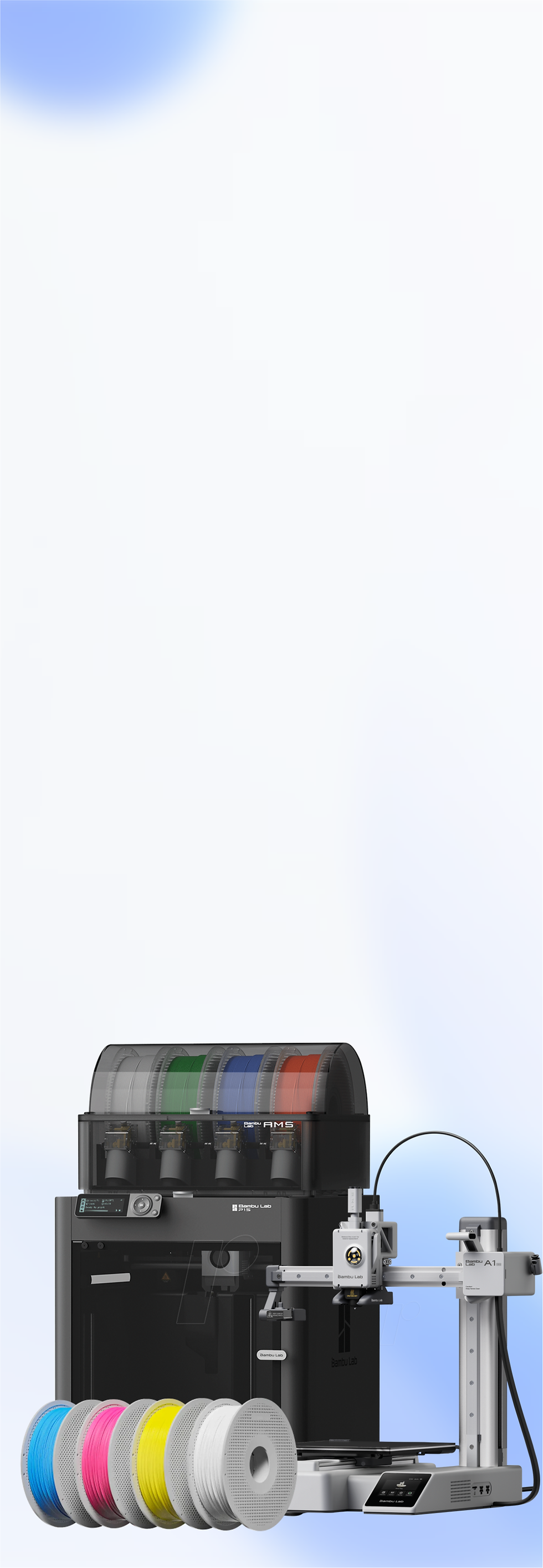
If you own a Bambu Lab A1, A1 Mini Combo, or X1-Carbon with AMS, you can print up to 16 colours in a single print using Bambu Lab PLA Basic spools. The AMS (Automatic Material System) manages filament switching automatically and works with Bambu Lab filament's RFID chips for seamless profile loading. For display models, figurines, product mockups, and creative projects, multi-colour FDM printing with Bambu Lab's filament system delivers results that are genuinely impressive without post-processing.
Why Buy 3D Printer Filament from Hydrotech 3D Chennai?
There are several places to buy filament in India. Here is what we offer that generic online marketplaces cannot:

Genuine, properly stored stock: Filament left in uncontrolled warehouse conditions absorbs moisture and degrades. Every spool we carry is stored correctly and dispatched in the manufacturer's original vacuum-sealed packaging with full shelf life remaining.
Material expertise you can actually use: Tell us your printer, your application, and your budget. We will tell you which spool to buy and what settings to start with. We have done this hundreds of times for customers across India.
Authorized Bambu Lab dealer: Bambu Lab filament in India requires an authorized distribution channel to guarantee genuine product. We are authorized. Counterfeit and grey-market Bambu Lab filament exists; it lacks the RFID chip, may have incorrect diameter, and will not trigger the correct slicer profiles on Bambu printers.
Fast delivery across India: Tamil Nadu orders typically ship within 24 hours. We pack filament securely to prevent spool damage in transit, a detail that matters more than it sounds for maintaining the vacuum seal.
Complete ecosystem: We stock the printers that run these filaments, the spare nozzles (including hardened steel for CF materials), and the build plate consumables. You will not need three separate vendors to get what you need.
Our customers who switch from generic marketplace filament to Bambu Lab or Elegoo from an authorized source consistently report fewer clogs, fewer failed prints, and more consistent surface quality. The difference is not marketing, it is diameter tolerance and moisture control. The cheapest spool is not the most economical spool when you factor in failed prints, wasted material, and time spent troubleshooting.
Frequently asked questions
Browse Our Full Filament Range
Use the product listings above to explore filaments by brand Bambu Lab and Elegoo each with dedicated category pages. If you need help choosing between materials, identifying the right nozzle type, or setting up your first multi-colour print workflow, our team is available at +91-9445390912 or in person at our store at Valasaravakkam, Chennai 600087. We print with this filament ourselves, we know how it behaves, and we will give you a straight answer.
